How to Choose Regulatory Compliance Consultants for UK Firms
Published Updated
You're probably at the point where the in-house team knows the regulatory task is real, but no one wants to own the risk of picking the wrong outside help. The brief is messy, the board wants certainty, and a few consultants all claim they can “handle authorisation” as if every route looks the same.
That's the trap. Good regulatory compliance consultants don't just know the rulebook, they know how to fit the work to the actual business model, evidence base, and regulator route. In the UK, that matters because compliance work is no longer a side activity, it sits inside a substantial advisory market, and the demand is being pulled by ongoing supervision as much as by one-off filings, with the wider UK consulting market estimated at £20.4 billion in 2023 after nearly doubling from £10.56 billion in 2018 (Equiteq market report). When firms get this choice wrong, they don't just waste budget. They burn time, create inconsistency across documents, and walk into regulator conversations underprepared.
Table of Contents
- Why Hiring the Wrong Consultant Is Costly
- Understanding Engagement Models and Deliverables
- Comparing Types of Compliance Providers
- Vetting Questions That Expose Capability Gaps
- Pricing, Timelines and FCA Service Metrics
- Building a Successful Engagement Framework
Why Hiring the Wrong Consultant Is Costly
The most expensive mistake is not hiring someone slow. It's hiring someone whose default process doesn't match the regulatory route in front of you. That's especially obvious in crypto, where firms often need help deciding whether they're even in scope before they spend serious money on a full application.
The FCA's crypto pages make the point plainly, firms providing in-scope crypto services to UK consumers need authorisation, and the route is changing from the current MLR registration model to a fuller FSMA authorisation regime (FCA cryptoassets information). The approval history shows why scoping matters so much. Since 2020, the FCA has received 412 crypto registration applications, approved 68, and withdrawn 263 (FCA crypto AML regime). A consultant who starts with templates instead of route analysis is forcing you into a process that may be wrong from day one.
The hidden failure is usually scoping
A bad engagement rarely looks bad at the start. The deck is polished, the workshop feels structured, and the consultant sounds confident. The problem appears later, when the regulator asks for clarity on activity, customer location, ownership of controls, or evidence that the business is ready to operate.
Practical rule: If the provider can't explain why your activity fits a specific route, don't let them touch the submission pack yet.
That is why founders should treat the evaluation phase as a gating step, not a formality. Ask whether the consultant has handled route selection, not just documentation. Ask how they identify the line between “needs authorisation now” and “needs a narrower or different filing path first”. If they can't answer that cleanly, they're selling labour, not judgement.
The other cost is regulatory fatigue. Every missing assumption has to be chased down, every inconsistency has to be reconciled, and every late change forces rework across the pack. The FCA's asset-management authorisation data shows why completeness matters, between 1 April 2023 and 1 April 2024 it determined 310 applications, approved 253, rejected 3, and withdrew 54, with 18% withdrawn or rejected due to poor-quality information or related concerns (FCA asset-management applications guidance). That's not a paperwork problem. It's a preparation problem.
Understanding Engagement Models and Deliverables
A consultant who cannot define the work shape is a risk transfer, not a safeguard. Founders should judge the engagement model before they judge the fee, because the contract shows who carries the burden when the regulator asks for a revision, a clarification, or fresh evidence.
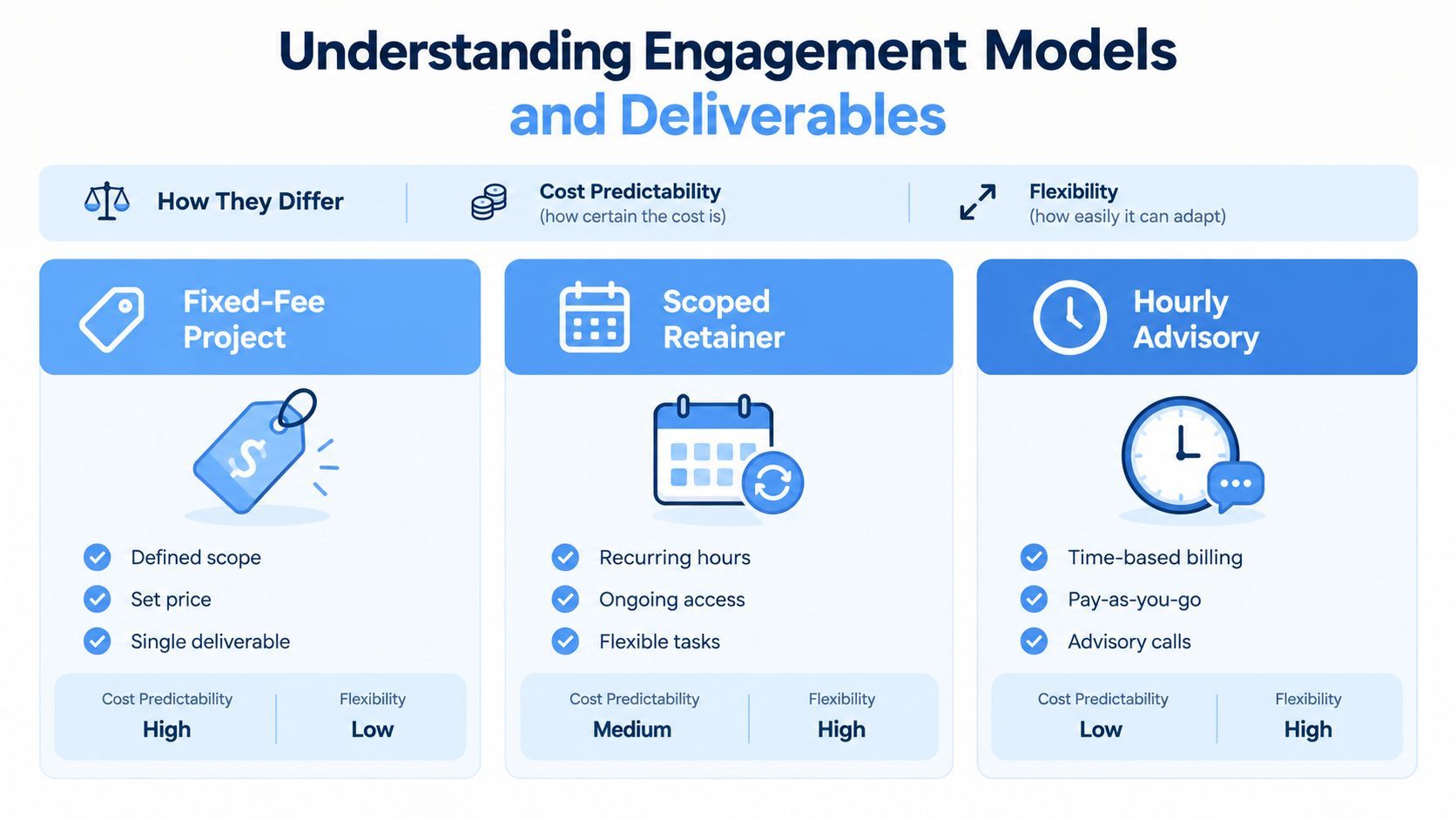
Fixed fee, retainer, and hourly work each fail differently
A fixed-fee project fits a route that is already defined and a fact pattern that is stable. It fails fast when the regulator opens a new line of enquiry, because the provider starts treating follow-up work as a change request instead of part of reaching a defensible submission. Use this model only when the deliverables are tightly listed and the assumptions are written down.
A scoped retainer suits businesses that need ongoing compliance support, recurring monitoring, or repeated change management. Its weakness is drift. If the scope is not documented properly, the consultant starts absorbing whatever feels urgent that week, and priorities become blurred. Use retainers for continuous support, not for a single filing with a clear endpoint.
An hourly advisory arrangement gives the most flexibility, and it demands the most discipline from the client. Set escalation triggers, track time, and keep a decision log, or the work expands without producing a clearer path to submission. Hourly work makes sense when the facts are still moving, but it becomes expensive noise if advice never gets turned into a submission-ready output.
A solid engagement separates what already exists from what still needs to be built. That includes operating procedures, financial assumptions, and any control evidence the consultant will rely on. The submission owner also needs to be clear. If the mandate allows the consultant to file on your behalf, the boundaries of that authority must be explicit.
Rule of thumb: No deliverables schedule, no start date. If the provider will not map outputs to the route, the engagement is under-specified.
Glentorion is one example of a firm built around scoped authorisation work, with preparation, review, submission, and interview support tied to the agreed mandate.
Comparing Types of Compliance Providers
Not every provider is built for the same job. A law firm, a large professional-services network, and a specialist boutique each bring a different kind of value, and founders who treat them as interchangeable usually regret it later.
Different firms miss different things
Law firms are strongest on legal interpretation, perimeter analysis, and drafting that has to survive close scrutiny. They can be less useful when the issue is operational implementation, system design, or evidence assembly across multiple business functions. If you need a judgement on what the rules mean, they're useful. If you need the whole submission pack held together across business, finance, and controls, that may not be enough.
Big-four style networks usually bring process discipline, project management, and the ability to coordinate large workstreams. Their weakness is generalisation. They can be excellent at structure but less sharp on the peculiarities of a specific route, especially where a niche market or a fast-moving product model changes the answer. The firm may look impressive and still miss the practical edge cases.
Boutique consultancies often bring deeper jurisdictional focus and closer contact with the actual file. That tends to make them stronger on nuance, but weaker if they can't integrate technology, evidence management, and cross-document consistency checks. In a complex authorisation, those gaps matter.
The best fit now often sits in the overlap between regulatory judgement and tooling. Submission packs are rarely ruined by a single bad answer. They're usually ruined by a series of small inconsistencies between the business plan, controls narrative, financial assumptions, and management responsibilities. That's why multi-jurisdiction experience matters, but only if it's real. Don't take a slick pitch at face value. Ask for actual submissions handled under the relevant regime, then verify whether the provider has worked through the transition from MLR registration to full FSMA authorisation where that's the issue.
Good providers don't just “know the rules”. They know how to keep the whole pack aligned when facts change.
Vetting Questions That Expose Capability Gaps
The easiest way to separate serious advisers from expensive decorators is to ask questions they can't answer with slogans. Founders usually ask about price first. They should be asking about failure handling, because that's where the true cost sits.
Ask how they deal with ambiguity, not just checklists
Start with route selection. Ask how they decide whether an activity is in scope, which jurisdiction matters first, and what they do when the business model doesn't fit neatly into one template. If the answer sounds like a generic process map, the provider probably hasn't considered your specific structure in enough detail.
Then move to evidence handling. Ask how they deal with inconsistent narratives across policies, business plans, financial assumptions, and control documents. A good consultant should be able to describe how they spot contradictions early, how they track changes, and how they decide what has to be corrected before anything is submitted.
You should also ask how they handle changing facts. New investors, altered responsibilities, revised product features, and updated operating arrangements all create knock-on effects. If the provider doesn't talk about impact analysis, they're not prepared for the actual world of regulated filings.
A strong consultant will also have a direct method for surfacing open questions quickly. That means they can explain which issues must be resolved by the client, which can be deferred, and which would stop the submission from being credible. Anything less usually means delays later.
Ask this outright, “What do you do when the facts don't line up?”
If they don't have a clear next-action discipline, walk away.
Finally, push on interview readiness. Accountable executives need to explain controls, responsibilities, assumptions, and decision-making without improvising. A consultant who can't prepare management for regulator interviews is giving you paperwork, not readiness. That distinction matters because regulator conversations often expose whether the submission is a living operating model or just a tidy document set.
Pricing, Timelines and FCA Service Metrics
Pricing should track scope, regulatory risk, and the amount of evidence the consultant has to clean up. If a provider prices from a polished pitch deck rather than the actual filing burden, expect scope creep or thin delivery. The UK consulting market is large, and compliance advice sits inside a bigger specialist services base. The Management Consultancies Association estimates the total UK consulting market at £20.4 billion in 2023, after it nearly doubled from £10.56 billion in 2018, with finance consulting at around 10% and risk and compliance services at around 5%. That points to a market with real depth, but also plenty of room for weak providers to hide.
Use regulator data, not vendor promises
For UK firms, timeline promises need to be tested against FCA service data. In Q1 2025/26, 99.1% of solo-regulated firm applications across all metric areas were determined within the statutory deadline, although 11 applications still missed deadline because of operational issues (FCA authorisations service metrics Q1 2025/26). In Q4 2025/26, the FCA said 97.6% of applications across all metric areas were determined within the deadlines, while 99.2% were determined within existing statutory deadlines only, measured end to end from receipt to determination (FCA authorisations service metrics Q4 2025/26).
Use those figures as a benchmark, not a promise. The FCA also publishes lower quartile, median, and upper quartile determination times by application category, which is exactly why a single timeline from a consultant is usually misleading. Route, filing type, and the quality of the starting materials change the clock. A provider who gives you one neat date without separating those factors is guessing.
The RevenueBase market report says the UK financial-services data, analytics and risk consulting market is worth about $5.8 billion, with responding to regulation at $1,115 million and compliance risk at $402 million, together about 26% of that market, and forecast compliance-risk spending growth at 8.5% in 2025, rising to 9.2% by 2027 (RevenueBase market report). Treat that as evidence of demand, not a reason to accept inflated fees. Good pricing buys route clarity, evidence discipline, and a submission that holds together under scrutiny.
Building a Successful Engagement Framework
A strong engagement begins with scoping, not drafting. It extends past submission into interview readiness. If the consultant starts by producing documents, the process is already backwards. The work should be structured around how the regulator will read the file, not around how the consultant prefers to bill.
The sequence should follow the filing, not the org chart
Start with the activity, jurisdiction, and source materials. Then test the business model, customer base, operating structure, and the difference between current and to-be-established arrangements. A capable consultant identifies what already exists and what is still an assumption that needs to be stated clearly.
Next comes the evidence architecture. Business plans, projections, controls, policies, and responsibilities need to line up. If one section says one thing and another says something slightly different, the regulator will notice. The consultant should coordinate facts, specialist input, and open questions until the pack reads as one position.
Controlled review comes after that. Findings should be tracked, corrections assigned, and changes pushed through every affected document. Many firms get this wrong because they treat review as a final polish instead of a consistency check.
Then the mandate matters. If the consultant can submit on the client's behalf, that authority needs to be explicit and recorded. If not, the client should know exactly what it owns. Either way, accountable executives should be ready for regulator interviews before the submission goes in, not after the regulator asks for clarification.
This framework works across regimes, whether you are dealing with FCA authorisation, DFSA registration, or a multi-jurisdiction process. It also matches the operating model Glentorion describes for its authorisation work, including scoping, preparing and reviewing application packs, and preparing management for regulator interviews. Good engagements cut rework because they treat evidence, ownership, and submission readiness as one process.
- regulatory compliance consultants
- FCA authorisation
- crypto regulation
- compliance hiring
- UK financial services